
 At last, we hear from the survivors.
As September began, a microphone was finally handed to the women who, as teenagers, served as party accessories for Jeffrey Epstein and his guests. Uranus (sudden clarity) was stationing in the sky, sending a bolt of lightning through the chaotic murk of the media ecosystem.
For months now, the Epstein saga has obsessed the nation’s punditry. As each new development bubbles into the news like putrid gasses from a fetid swamp, it’s pounced upon by talking heads from both sides of the culture war.
The diehard red-hats see the scandal as a chance to cop a glorious, long-promised reveal: something to validate and vindicate their deep-state fantasies. The Trump resistance sees the scandal as a chance to split the MAGA ranks and rouse the Democrats to strike a winning blow.
The conventional media, hardwired to approach every issue the same way, has been in its glory, tallying up the political costs (not “political” in the broad sense, of power dynamics – e.g. between men and women, privileged and underclass — but “political” in the narrow partisan sense).
Precious little attention has been paid to the human costs.
Knife fight
For better or worse, most of us absorb the news as the talking heads dole it out. We’re conditioned to view everything in collective life as a series of one-upmanship games played by two rival teams. The Epstein drama is presented as just one more point-scoring opportunity among many in this ugly American moment.
But imagine how history will interpret this hideous episode. Will future historians view it solely as a knife fight between political factions? From the distance of a decade or two, what will observers think, when they hear about all these well-connected men treating vulnerable young girls  as sexual playthings, only to be discarded like used Kleenex when they aged out?
Epstein and Maxwell selected the teenagers not only for their looks and inexperience (“the younger the better”) but for their fragile socioeconomic backgrounds. They knew that if they chose victims from the wrong side of the tracks, it’d be less likely that the girls would get support from the law, the police, or their own families.
There’s a lot of pain at the bottom of this pit. – James Carville
Nail their names to a tree
To place this twisted scenario in context, we have to back up from the media coverage. With enough perspective, we might see the fractious campaign to release the notorious files as a milestone.
 Regardless of the confused motives in play, and regardless of which faction ends up being crowned the winner, the episode is significant because of the issues it is raising. Something is being announced from the rooftops that was never announced like this before.
Slowly – agonizingly slowly, for most of us – the modern world is shifting its understanding of sexual assault. In past centuries, even just 50 years ago, the way American society handled rape was, almost unilaterally, to shame the victim.
The more powerful the perps were, the less likely they were to be even named, let alone punished. If the crime was reported at all, it never made the headlines. And goddess knows, this is the way it still is, in Turkey, Afghanistan, Nigeria and too many other places to name.
Human societies have handled sexual politics in different ways in different eras and places, with the constant being the X factor that underlies all social change: consciousness. And group consciousness is not fated; it is mutable. To see it this way keeps us out of myopic despair, and reminds us what we’re fighting for.
It might be useful to imagine, for example, how different power dynamics must have been six or seven millennia ago, before the patriarchal revolution and the takeover of the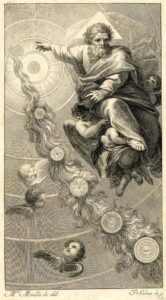 sky gods.
Or in those premodern villages where a rapist’s name was posted to a tree in the town square — shaming the perpetrator, not the victim.
Out of the blue
Transpersonal astrology sees the three outer planets (Uranus, Neptune, and Pluto) as introducing spikes of consciousness. For individuals, they compel change by violating our assumptions. For groups, they interrupt the dominant narrative.
Like the lightning god of classical myth, Uranus transits shock and destabilize. They inspire us to break rank.
It was a classic Uranian moment when Nancy Mace, red-nosed and weeping, bolted out of that meeting in the congressional chambers where Epstein’s victims were telling their stories. Whatever explanation we attach to her action, it momentarily upset the partisan apple cart.
Not to kid ourselves about Mace, a staunch Trump loyalist who, a day later, defended her “hero,” the scumbag who’s now calling the Epstein files “a hoax.” What is of interest here is the mysterious workings of group consciousness. Mace’s sudden flight was one of those glitches that rips a hole in the official fabric.
If only for a moment, she was a conduit for something bigger than her politics or her personality. Indeed, both would have kept her in that room, if they could have.
 Lightning strike
Any readers who have a transpersonal planet strong in their natal chart know about these spontaneous malfunctions. And all of us experience them periodically, because these planets are always transiting somewhere. If we don’t resist their influence, we receive a revelation of some kind, right on time.
If you’re due for a Uranus transit — check your chart for the first few degrees of Gemini — allow yourself to be slapped into a heightened alertness. You might wake up from delusions and complacencies you didn’t even know you had. You might be zapped into realness, like Mace, who was momentarily thrown off her political bullshit and obfuscation.
This is the way lightning works. The night landscape is suddenly illuminated in a flash, with darkness immediately before and darkness immediately afterwards. But in that split second, we see everything, and, if we’re smart, we don’t forget what we saw.
Images
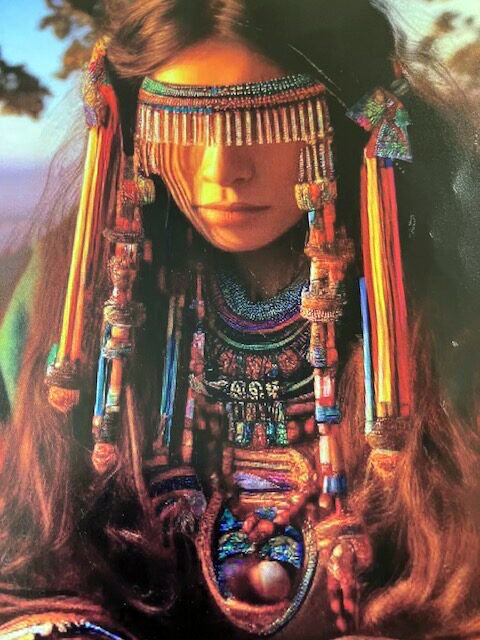
The Big Time, Miwoks autumn celebration
Epstein & Maxwell, CNN
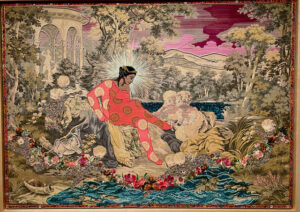
“She walked in reverse and found their songs,” 2024, Suchitra Mattai, Guyana, b. 1973, found tapestry
illustration to the Spanish translation of Buffon’s ‘Histoire Naturelle’, c.1785-1804 Fernando Selma and Mariano Salvador Maella